Best Window Coverings for Sliding Doors: Match the Covering to How the Door Works
The best window coverings for sliding doors are the ones that protect privacy and manage light without making the door frustrating to use. Wide glass doors create a design opportunity, but they also demand careful decisions about stacking space, daily traffic, furniture placement and how much of the view should remain visible.
For Melbourne homes, common choices include panel blinds for sliding doors, sheer curtains for sliding doors and linked roller blinds. Each option behaves differently across a wide opening. This guide compares the strongest wide glass door coverings and explains when custom window furnishings are worth the investment.
Start With the Door’s Movement and Daily Traffic
A covering should move in a way that supports the door. Sliding doors open sideways, so panel systems and curtains can follow the same direction. Roller blinds move vertically and may need to be raised before someone walks through. That can be fine for a door used occasionally but inconvenient for a main connection to a deck or backyard.
Observe which panel opens, where people walk and how much wall or ceiling space is available. Also note handles, pelmets, air-conditioning outlets and nearby furniture. These details determine whether the covering can stack cleanly without blocking access.
Panel Blinds for Sliding Doors
Panel glide blinds use broad fabric panels that travel along a track and stack to one side or split from the centre. Their horizontal movement suits wide openings and creates a clean, contemporary look. Fabrics can be selected for sunscreen, light-filtering or blockout performance.
The main decision is stacking space. The panels remain visible when open, so the track and stack should be planned around the active door panel and view. Panel blinds work particularly well when nearby roller blinds can use a coordinated fabric.
Sheer Curtains for Sliding Doors
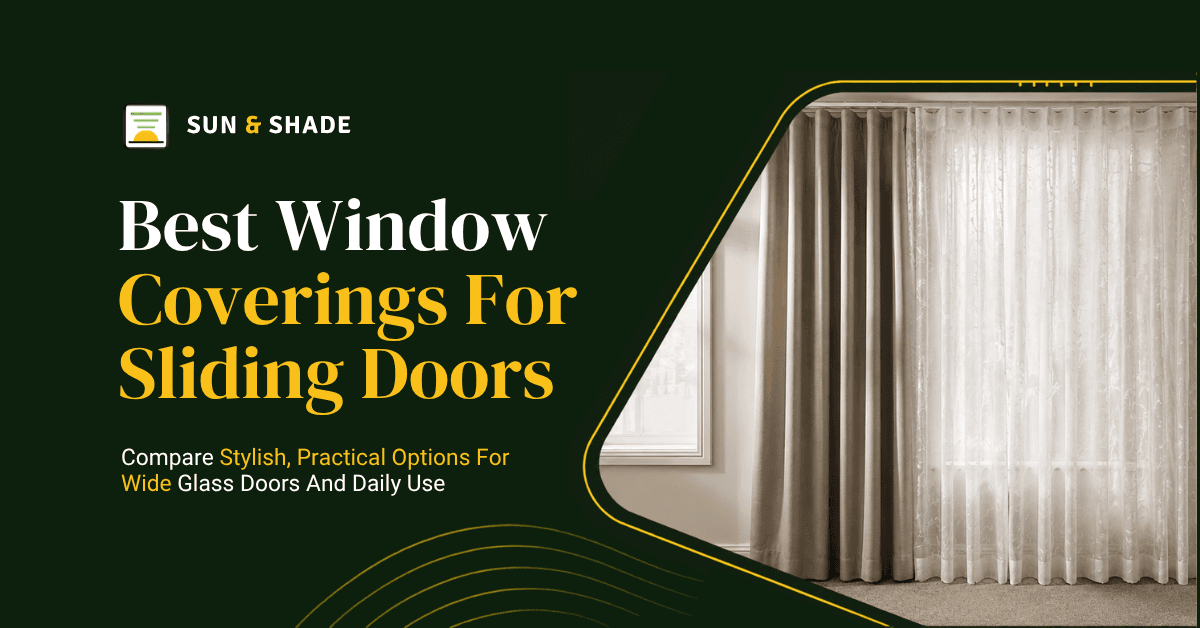
Sheer curtains soften large areas of glass and allow daylight to enter while improving daytime privacy. Ceiling-mounted S-fold styles create a continuous vertical line and can make a room feel taller. They also move easily across a long track for frequent door access.
Sheers alone do not provide strong nighttime privacy when interior lights are on. Pair them with blockout curtains or a blind when the room needs evening privacy, glare control or darkness. The layered approach offers more flexibility but requires sufficient track depth and stacking space.
Linked Roller Blinds for a Minimal Look
Linked roller blinds use multiple blinds across a wide opening and can reduce the amount of fabric raised at one time. Dividing the system around door panels may allow the active section to open while the remaining glass stays covered.
They suit minimalist interiors and store compactly above the opening. However, access requires vertical movement, and wide systems need careful bracket, control and fabric planning. Small gaps between linked blinds are normal and should be considered where total blockout or privacy is critical.
Option | Best for | Watch for |
|---|---|---|
Panel glide blinds | Wide openings, modern interiors, side-stacking access | Visible stack when open |
Sheer or S-fold curtains | Soft style, frequent access, filtered daylight | Needs a second layer for night privacy |
Linked roller blinds | Minimal appearance and compact top storage | Vertical operation and light gaps |
Why Custom Window Furnishings Matter for Wide Doors
Large sliding doors rarely match standard retail dimensions perfectly. Custom window furnishings can account for exact width, ceiling height, active door panels, fabric weight, control position and the space required when the covering is open.
Sun & Shade can assess the opening and recommend a made-to-measure configuration based on privacy, light and everyday movement. The consultation should also confirm available products, installation conditions and whether layering is practical for the room.
Use a Five-Factor Decision Check
Choose the final option by rating door access, privacy, light control, stack space and interior style. For a high-traffic family room, smooth side movement may be the priority. For a media room, blockout and gap control may matter more. For an apartment with a view, filtered daylight and a compact open position may lead the decision.
Samples should be viewed in the room at different times of day. A fabric that looks opaque in a showroom can behave differently against bright outdoor light, and a sheer that feels private in daylight may not perform the same way at night.
Match the Option to the Room
In an open-plan living room with frequent backyard access, side-moving sheers or panel glides often support traffic better than one large roller blind. In a bedroom with a sliding balcony door, blockout performance and privacy may justify layered curtains or separately operated roller sections. In a rental or compact apartment, a simple, durable system with minimal wall projection may be the priority.
Motorisation can improve operation on very wide or heavy coverings, but it adds power, control and servicing considerations. Confirm how the covering can be operated during a power or battery issue and whether the motor position affects the stack or headrail.
Before ordering, measure the full opening, ceiling height, distance to handles, wall space on both sides and clearance above the frame. Professional measurement is particularly valuable where floors or ceilings are uneven, because small differences become visible across a wide span.
Frequently Asked Questions
What are the best window coverings for sliding doors?
Panel glide blinds, sheer or S-fold curtains and linked roller blinds are common strong options. The best choice depends on how often the door is used, the required privacy and the available stacking space. A custom measure helps confirm what will operate smoothly.
Are panel blinds suitable for wide sliding doors?
Yes. Their broad panels move sideways on a track, which suits wide openings and sliding-door movement. Plan where the panels will stack so they do not block the active door or the most important part of the view.
Do sheer curtains provide privacy on sliding doors?
They can improve daytime privacy while allowing filtered light, depending on fabric and exterior brightness. At night, interior lighting may make the room visible from outside. Add a blockout curtain or blind when full evening privacy is required.
How do linked roller blinds work on wide glass doors?
Several roller blinds are installed across the opening, sometimes with linked controls or coordinated brackets. Sections can align with different door panels. They provide a minimal look but require vertical operation and may have small gaps between fabrics.
Why choose custom window furnishings for sliding doors?
Custom products are measured for the exact opening, controls and stacking requirements. This improves fit, movement and visual proportion. It also allows fabrics and operation to be selected for the room rather than forcing a standard size onto a large opening.
Conclusion
The best covering is determined by the door’s behaviour before its decorative style. Map the active panel, traffic and stack space, then compare panel glides, sheers and linked rollers against privacy and light needs. A correctly measured custom system should make the